
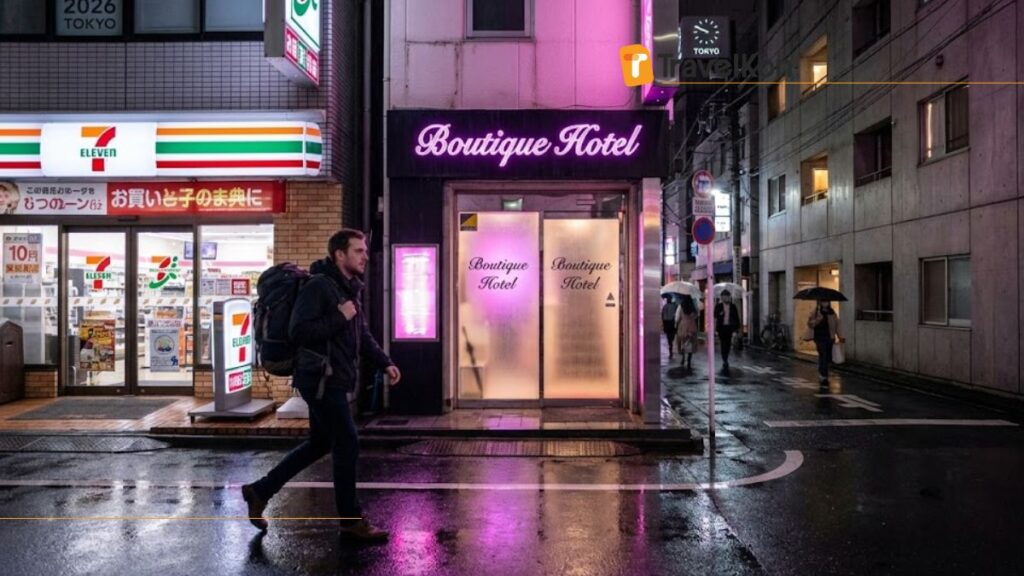
- Love hotels in Japan number over 30,000 nationwide, generating an estimated ¥4 trillion (approx. $26 billion USD) annually; making them a legitimate pillar of the country’s accommodation economy.
- Short stays (“rest”) typically run ¥3,000–¥6,000 (approx. $20–$40 USD), while overnight stays range from ¥8,000–¥20,000 (approx. $53–$133 USD) depending on theme and location.
- Foreigners can legally use love hotels in Japan, though some properties in quieter districts may decline non-Japanese guests; major city hubs like Shibuya and Osaka are consistently foreigner-friendly.
Japan builds its reputation on discretion. Vending machines sell beer quietly. Restaurant orders are placed on tablets. And somewhere tucked between a Family Mart and a neon-lit pachinko parlour, a love hotel sits behind frosted glass, offering something that much of Japan’s everyday architecture simply cannot: privacy. These are not seedy backroom operations. They are a functioning, deeply embedded part of how Japanese couples; from newlyweds to retirees; carve out intimate space in a country where apartment walls are thin, extended families often share homes, and the concept of personal space is negotiated, not assumed. For the backpacker or couple visiting Japan for the first time, a love hotel is worth understanding, whether or not you plan to stay in one.
Staying connected while you explore Japan matters more than most travellers anticipate. A Prepaid Japan eSIM with Instant Activation works across urban centres like Tokyo, Osaka, and Kyoto, and continues to perform reliably in smaller regional towns and even rural train corridors; useful when you’re navigating unfamiliar neighbourhoods at night. Unlike physical SIMs, an eSIM activates before you board, which means you arrive with working maps, translation apps, and Google Translate camera mode already functional. For travellers moving between cities quickly, this removes one layer of logistical friction from an already information-dense trip.
Beyond the Taboo: What Exactly Is a Japanese Love Hotel?

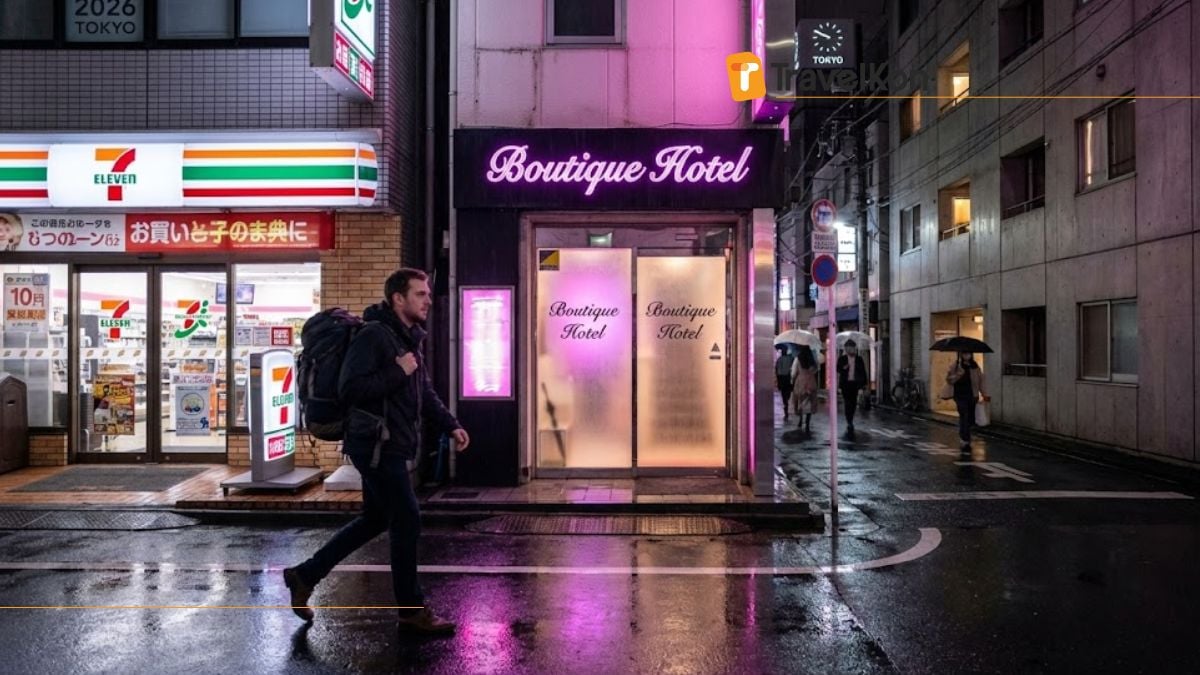
A love hotel in Japan is a short-stay accommodation designed entirely around privacy; and the concept carries far less stigma domestically than the name implies abroad. These are legitimate, licensed businesses that cater primarily to couples seeking space away from shared apartments, family homes, or the relentless proximity of urban daily life. The cultural context matters: Japan has one of the world’s highest urban population densities, and multi-generational households remain common in both cities and rural areas. For many couples, a love hotel is not an indulgence; it is a practical solution.
Historically, the concept evolved from discreet “tea houses” and inns offering private rooms for couples during the Edo period (1603–1868). By the 1970s, these had shifted into purpose-built architecture; often deliberately gaudy, with castle turrets or rocket ship facades; designed to signal their function without a literal sign. Today, many have rebranded as “fashion hotels” or “boutique hotels,” with sleeker interiors and a more contemporary aesthetic. The neon excess is still there if you want it. So is the discretion.
“Rest” vs. “Stay”: Understanding the Pricing Models
The single most important thing to understand before walking into a love hotel in Japan is that there are two distinct pricing structures, and confusing them will cost you money.
A “rest” (休憩, kyukei) is a timed day-use booking, typically available during afternoon and early evening hours. You select a room for a block of two to four hours. Prices for rests generally run ¥3,000–¥6,000 (approx. $20–$40 USD / €18–€36 EUR). This option is popular for couples wanting a quiet break mid-afternoon without committing to an overnight stay.
A “stay” (宿泊, shukuhaku) is an overnight booking, usually available from around 10:00 PM through to 10:00 AM or 11:00 AM the following morning. Overnight rates vary significantly by location and theme, ranging from ¥8,000–¥20,000 (approx. $53–$133 USD / €49–€122 EUR). Weekend and holiday pricing runs noticeably higher.
Warning: Most love hotels operate a strict no-exit policy once you’ve checked in. If you leave mid-session; even briefly to grab a convenience store snack; you will typically be charged for a new booking upon re-entry. Plan accordingly.
The High-Tech Check-In: A Lesson in Anonymity
Japan has quietly perfected the frictionless, human-free transaction, and love hotels are among the clearest expressions of this. The check-in process is designed to eliminate any need for face-to-face interaction between guests and staff.
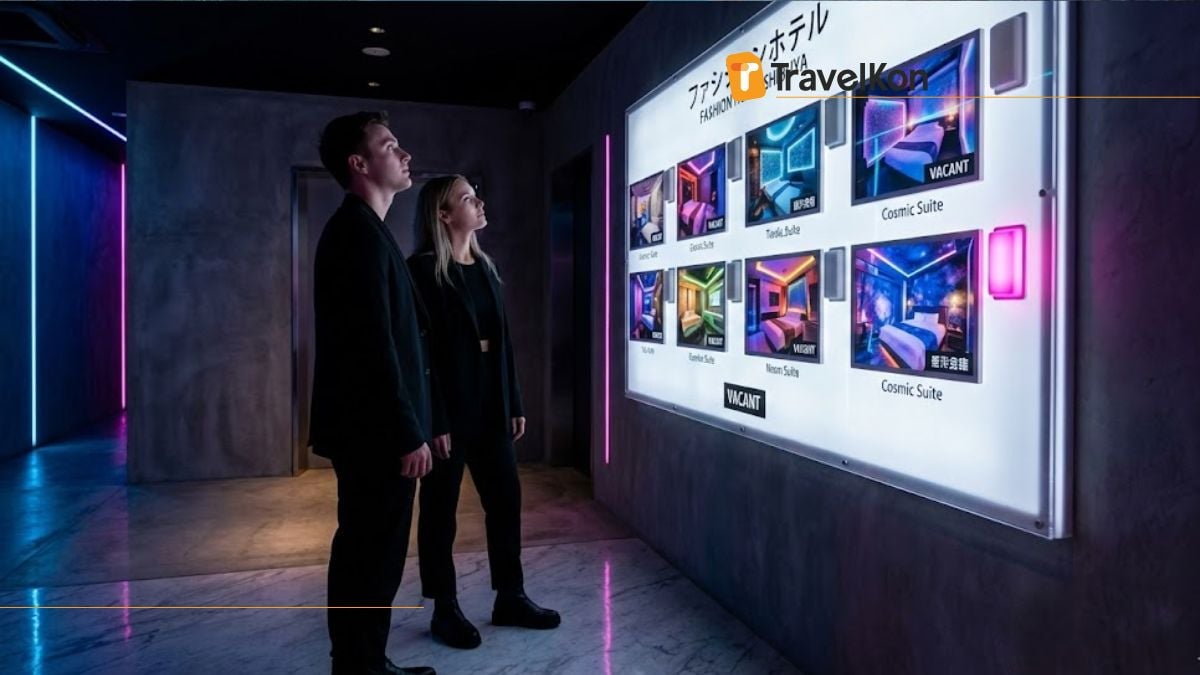
On entering the lobby, guests are presented with a backlit photo board; a panel displaying photographs of available rooms, each with its price and booking type. Available rooms are illuminated; occupied rooms go dark. You select your room by pressing the corresponding button.
Payment is handled at a machine or through a small counter window with a sliding tray; in some older establishments, a frosted screen ensures you never actually see the staff member processing your transaction. No names are logged. No ID is typically required. Cash remains the traditional default, though newer properties accept IC cards (like Suica) and some now take credit cards.
Pro-Tip: Some newer love hotels have fully digital kiosks with English-language interfaces. Shibuya’s Dogenzaka district has enough tourist-friendly options that the learning curve is minimal for first-timers.
Wild Themes and Outrageous Amenities
This is where a love hotel in Japan departs entirely from the standard accommodation conversation. The rooms are not just private; many are theatrical.
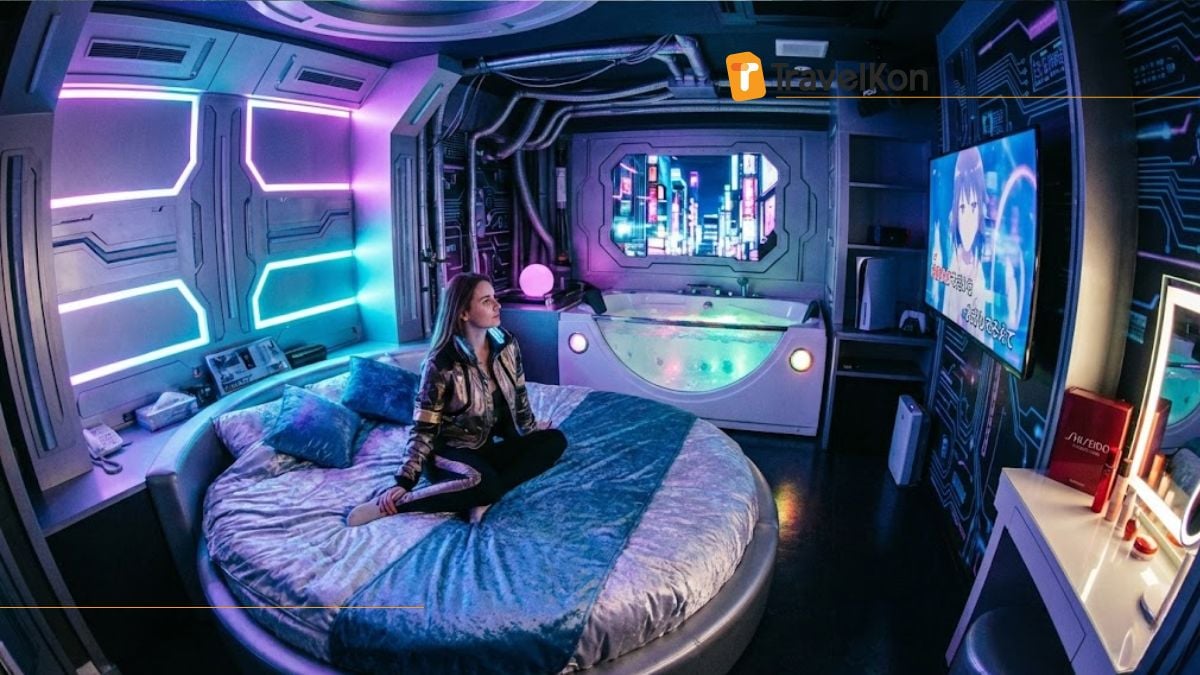
Themed rooms range from the immediately recognisable (Hello Kitty, Sailor Moon, traditional Edo-period interiors) to the genuinely surreal: functioning doctor’s office setups, school classroom aesthetics, baroque European palace rooms, and full sci-fi spacecraft environments. The level of design detail is frequently impressive.
Beyond the theme, the in-room amenities at mid-to-upper tier love hotels often exceed what you’d find at a three-star business hotel:
- Whirlpool baths with mood lighting and colour-changing LED systems, some large enough for two
- Karaoke machines with full song libraries, contained acoustically within the room
- Gaming consoles and large-screen TVs with video-on-demand libraries, including international content at some properties
- High-end bathroom products; Shiseido amenities are not uncommon
- Cosplay rental; some hotels offer in-room costume catalogues guests can browse and order from
The quality of linens, bathroom fixtures, and climate control in a well-maintained love hotel regularly outpaces budget and mid-range business hotels at the same price point. The industry is competitive, and amenities are the primary differentiator.
Can Tourists Actually Stay There? Rules and Etiquette
Yes; foreigners can use love hotels in Japan, and in major cities, most welcome international guests without issue.
A few practical points are worth knowing before you arrive:
The two-person rule is standard across the industry. Love hotels are designed and priced for couples, not groups. Three people checking in together is typically not permitted, and some older establishments in conservative areas may still decline same-sex couples, though this is becoming increasingly rare in urban centres.
Luggage is a real constraint. Love hotel rooms are compact and not designed with large backpacks or rolling suitcases in mind. They are not a practical option for travellers who need to store gear or arrive before the standard afternoon check-in window.
Booking methods vary. The majority of love hotels remain walk-in only and do not appear on mainstream platforms. A small but growing number have listings on Agoda or aggregators that specifically serve this category. For a particular themed room, walk-in on a weekday afternoon offers the best selection and least competition.
Warning: Is renting a love hotel 18+ in Japan? Yes; guests must be 18 or older. This is consistently enforced, and younger-appearing guests may be asked for ID.
Where to Find the Best Fashion Hotels in Japan
The geography of love hotels in Japan follows a recognisable pattern: clusters near entertainment districts, transit hubs, and dense residential areas.
Shibuya’s Love Hotel Hill (Dogenzaka), Tokyo is the most well-known concentration in the country. Hundreds of hotels occupy the sloped streets just west of Shibuya Station. The range is enormous; from budget rests to elaborately themed overnight suites. For first-timers, this is the most foreigner-navigable option.
Shinjuku (Kabukicho), Tokyo sits adjacent to one of Tokyo’s most famous entertainment districts. The hotels here lean toward neon-heavy, unapologetically loud aesthetics. Foot traffic is dense and the atmosphere more charged than Dogenzaka.
Uguisudani, Tokyo is less visited by tourists and worth noting for that reason. The love hotels here are older, more modest, and noticeably cheaper. The aesthetic is retro rather than theatrical, and the clientele tends to be local rather than tourist-curious.
Osaka (Dotonbori/Namba) offers some of the most extravagantly themed rooms in Japan. Osaka’s general cultural energy; louder, more playful, more overtly fun than Tokyo; carries directly into its love hotel aesthetic. The Namba area is the logical starting point.
Safety and Hygiene: The Gold Standard
For travellers who approach this category with understandable scepticism, Japan’s love hotels consistently earn high marks on both counts.
Cleanliness in this industry is not a pleasant surprise; it is a baseline expectation the market enforces. Rooms are cleaned and reset between every booking. Linens are changed without exception. Bathroom facilities, in many cases, are more rigorously maintained than those in standard tourist hotels, because a hygiene complaint is commercially damaging in a way that is immediate and direct. The cleaning standard at even budget love hotels typically exceeds what you’d encounter at a mid-range hostel.
Safety is similarly robust. Love hotels are licensed, regulated, and monitored as standard hospitality businesses. They are not associated with crime, and the anonymity of the system works in the guest’s favour. Solo female travellers who visit hotels that accept solo guests; a minority, but they exist; report consistently safe experiences. Foreign couples report no safety concerns distinct from any other Tokyo or Osaka neighbourhood.
The “hourly hotel” framing that carries negative connotations in some other countries simply does not translate here. Japan’s love hotels are a very Japanese solution to a very universal human need for privacy; executed with the attention to detail and operational precision that defines the country’s hospitality culture at every level.
Japan rarely does things without intention. A love hotel in Japan is no exception; it emerged from genuine social need, evolved through decades of design competition, and now sits as one of the more fascinating intersections of utility and spectacle in the country’s accommodation landscape. Whether you visit out of curiosity or practicality, understanding how they work removes the mystique and leaves something more interesting: a window into how a densely populated, privacy-conscious society quietly builds space for the parts of life that don’t fit elsewhere. Pair that understanding with a working phone and a best eSIM Japan before you arrive, and you’re navigating the city on your own terms from the moment you land.

