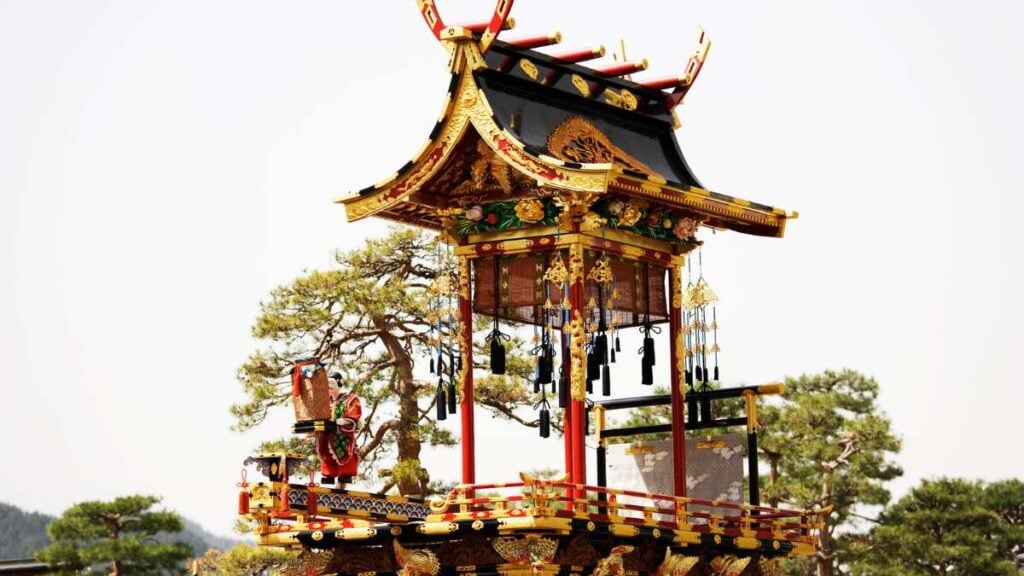
Takayama in autumn has a way of slowing everything down, then surprising you all at once. Streets fill with carefully preserved floats, each one detailed to a level that feels almost excessive until you see them move. The Takayama Autumn Festival 2026 is expected to follow its usual October schedule, drawing visitors who want something quieter than Kyoto yet just as memorable.
Planning here comes down to timing your arrival and staying connected between events. It simply helps to review Japan eSIM options for your festival trip before you go, so maps, updates, and transport changes stay easy to manage.
Note: This year’s important exception is the float collection. 10 floats will be displayed instead of the traditional 11 because Gyojintai is undergoing repairs.
When Is the Takayama Autumn Festival in 2026?
The autumn celebration is Hachiman Matsuri, the festival of Sakurayama Hachimangu Shrine. For your Takayama Festival October visit, use this timetable. All times are Japan Standard Time (UTC+9) and should be treated as approximate.
| Event | Friday 9 October | Saturday 10 October |
| Stationary float display | 09:00–17:00 | 09:00–16:00 |
| Hotei-tai puppet performances | 12:00 and 14:00 | 11:00 and 13:00 |
| Goshinko ceremonial procession | 13:20–15:30 | 08:30–12:00 and 13:30–16:00 |
| Afternoon float parade | 13:30–15:30 | Not scheduled |
| Lantern-lit evening festival | 18:00–21:30 | Not scheduled |
We recommend Friday for the fullest programme and lantern displays, and Saturday for clearer daytime viewing. Staying both days gives you another look at the floats in daylight, but there’s no substitute for the lantern night.
Which Floats and Performances Should You Prioritise?
For the best experience, build your visit around the stationary floats, Hotei-tai’s puppets and Friday’s lantern procession. Daylight reveals the workmanship while evening viewing reveals how the floats move through town.
Look for These Details During the Float Display
During yatai hikizoroe, the floats stand along the shrine approach, with Hotei-tai inside the precinct. Instead of taking the same photograph of every float, look for these distinguishing features:
- Daihachi-tai: its three-wheel structure includes outer wheels measuring 1.56 metres across. Its open middle level resembles a palace pavilion.
- Kinpo-tai: a golden phoenix spreads its wings above the roof. The figures include Empress Jingu and Takenouchi no Sukune, who holds the infant Emperor Ojin.
- Jinma-tai: look for the white horse and attendants, then the striking embroidered mask on its hanging fabric.
Watch Hotei-tai’s Puppet Sequence
Hotei-tai’s karakuri performance is more than a row of dolls moving on a platform. Child figures cross rotating supports, then leap onto Hotei’s shoulders. The finale brings a banner out of the fan held in Hotei’s left hand.
The mechanism uses 36 control strings. Watch the transfer between supports.
Choose one performance. For planning, aim to reach the precinct about half an hour beforehand, without treating that buffer as a guarantee of admission. A train arriving shortly before midday leaves little room for luggage storage and the walk from the station.
Choose Between the Afternoon Events
Friday’s float parade moves four floats through town. Goshinko carries the shrine’s deity in a portable shrine, accompanied by traditionally dressed participants, lion dancers and ceremonial performers.
The afternoon puppets overlap with both processions. Choose midday puppets for more procession time, or afternoon puppets if arriving later.
Pick an Evening Position With a Practical Exit
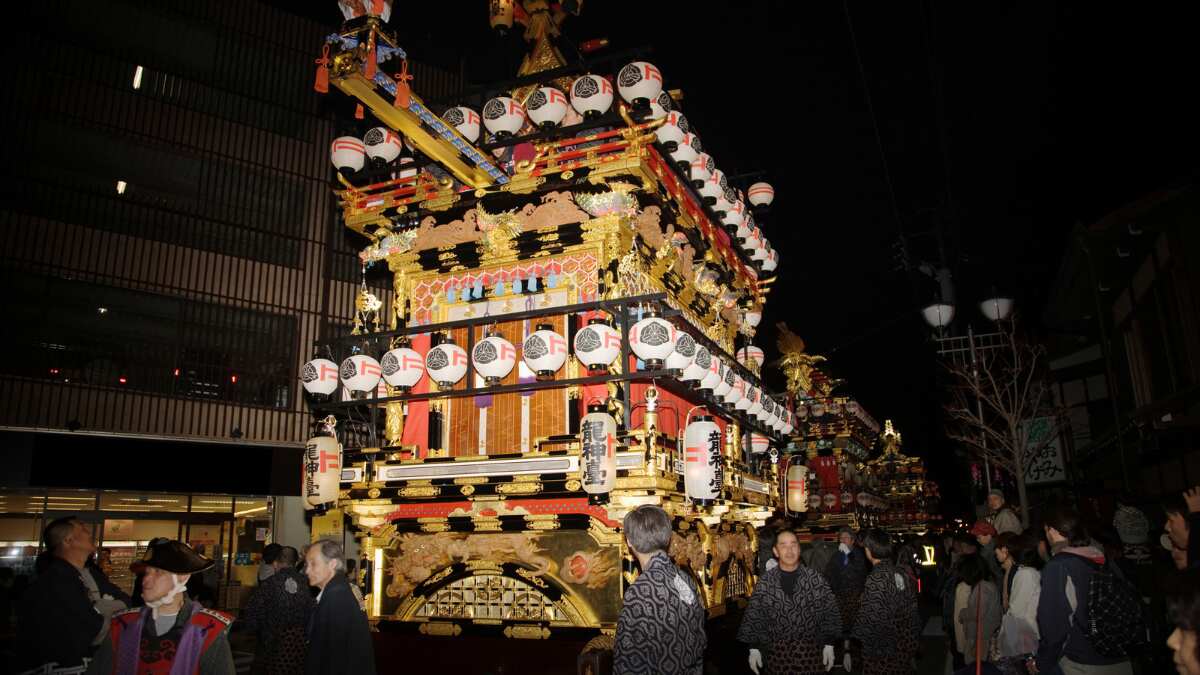
During yoimatsuri, each float carries approximately 100 lanterns. The evening route passes through Daishinmachi, Shimoninomachi, Yasugawa Street and Shimoichinomachi.
Open the festival locations and restrictions map, then choose a position that also suits your walk back. Float passage times vary by street.
If your tour regroups at Takayama Betsuin, avoid Yasugawa Street. Crowding and blocked crossings can prevent a timely return. Shimoninomachi or Shimoichinomachi are the suggested alternatives for those groups.
A Friday Itinerary That Accounts for Overlapping Events
The plan below assumes local accommodation and prioritises the midday puppets and part of one afternoon procession, rather than promising every event in full.
| Time | Suggested Plan |
| Morning | Arrive, leave luggage and walk to the festival district |
| Around 10:30 | Examine the stationary floats |
| Around 11:00 | Eat an early lunch or substantial snack |
| Around 11:30 | Reach the shrine precinct for the midday performance |
| 12:00 | Watch the scheduled puppets |
| After the performance | Take a break, then move towards your chosen procession route |
| From 13:20 or 13:30 | Watch part of Goshinko or the float parade |
| 16:00–17:00 | Rest, eat and collect a warmer layer |
| Before 18:00 | Return for the lantern procession |
Use this sequence only if your booked arrival leaves enough time. For a late arrival, skip the morning circuit, choose the afternoon puppets and keep the remaining afternoon flexible.
A fixed ryokan dinner can clash with evening viewing, so arrange an earlier meal, or choose a room-only stay and eat before heading back out.
How Do You Reach Takayama by Train or Bus?
Takayama lies in Gifu Prefecture’s mountainous Hida region. Compare these approaches, then select your preferred service.
| Starting Point | Route | Approximate Journey Time | Main Booking Decision |
| Nagoya | Direct Limited Express Hida | 2 hours 20 minutes; allow roughly 2½ hours for planning | Reserve your preferred departure |
| Tokyo | Tokaido Shinkansen to Nagoya, then Hida | Roughly 4½–5 hours including a transfer allowance | Book a workable Nagoya connection |
| Toyama | Direct Limited Express Hida | 1 hour 30 minutes | Select a direct departure that suits your viewing plan |
| Matsumoto | Bus via Hirayu Onsen | Approximately 2 hours 20 minutes | Reservation required |
| Nagoya | Highway bus | Approximately 2 hours 45 minutes | Reservation required |
Tokyo’s figure includes an editorial transfer allowance; it is not a published duration for a particular connection. Keep in mind that road conditions can delay buses.
When travelling around Takayama and nearby regions during festival season, it helps to understand how connections, timetables, and regional routes work, especially if you’re unfamiliar with the system, so reading about using trains and local transport in Japan can make moving between towns, events, and cities much easier to plan throughout your trip in Japan smoothly.
Work Backwards From Your Return Booking
For a same-day trip, subtract walking, boarding and crowd-exit time from your booked departure to set your latest viewing finish.
If the calculation cuts through the lantern programme, choose partial viewing or stay locally. Do not assume a later service will be available.
Driving Has a Different Evening Cut-Off
Takumigaoka’s temporary parking area has a free shuttle to the civic cultural centre, followed by a walk to the festival. Friday’s published shuttle operation ends at 21:00, before the evening festival’s approximate finish.
Plan your exit around reaching that shuttle, rather than watching until the procession ends.
Where Should You Stay?
For the lanterns, prioritise accommodation within walking distance of your viewing area. For daytime events followed by a rail departure, the station area offers simpler luggage handling.
| Base | Best Fit | Practical Trade-Off |
| Takayama Station area | Rail arrivals, luggage storage and an early departure | A longer walk from northern evening viewing areas |
| Northern old town, beyond Yasugawa Street | Breaks between shrine events and lantern viewing | Street noise and restricted vehicle access |
| Outside central Takayama | An alternative when central rooms are unavailable | Your return connection sets the viewing limit |
Check the hotel’s location against your chosen route, not just an “old town” label. A southern sightseeing base is not automatically close to this northern festival.
Ask about restricted-street access and luggage storage. For sold-out properties, enquire directly about cancellations.
Hida-Furukawa and Gero Onsen can suit a wider itinerary, but neither provides an automatic late-night solution. Establish the return connection before paying for the room.
Walking from the Station
The shrine area is approximately 20 minutes from Takayama Station under ordinary conditions. Leave through the east exit towards the town centre and Miyagawa River, then continue into the northern district beyond Yasugawa Street.
Use the festival map for the final shrine approach and temporary restrictions. Festival crowds can lengthen the walk.
What Happens If It Rains?
Events may be reduced, relocated or cancelled. Please remember that cancelled events are not postponed to another date.
Possible adjustments include viewing floats in their storage buildings and moving the puppet performance to Sakurayama Nikkokan. Access depends on the day’s conditions.
Choose a Nearby Indoor Alternative
The Festival Floats Exhibition Hall offers rainy-weather viewing of four floats with paid admission. Establish the day’s access arrangements before making it your fallback.
Takayama Jinya’s former government offices offer rooms and exhibits near Nakabashi, south of the festival district. Published October hours are 08:45–17:00, with individual admission of ¥500. Visitors aged 18 or younger enter free. Temporary closures remain possible.
Bring an Evening Layer
Early October’s historical average maximum is 22.0°C, compared with an average minimum of 11.8°C. These are 1991–2020 climate averages, not the festival forecast.
If you’re heading to Takayama during autumn, it also helps to think through layers, weather shifts, and cooler evenings, so checking what to pack for autumn in Japan can make it easier to stay comfortable from daytime festival crowds through to the colder nights without overpacking or missing essentials.
A Short Before-You-Go Checklist
- Keep the programme, route map and transport bookings available offline.
- Store your hotel address in Japanese and English.
- Agree on a meeting point and carry a charged power bank.
- Install your eSIM using its plan-specific instructions, including when validity begins.
Before you arrive in Japan, check Japan entry requirements for Australians so you know exactly what’s needed for entry and how long you can stay.
It’s also worth setting up your phone with the right travel apps for Japan, so navigation and train updates are already in place when you start moving between cities and festival stops.
FAQs
Is the Takayama Autumn Festival Free?
Public street viewing is free. Paid attractions, including the Festival Floats Exhibition Hall, have separate admission charges.
Can You Reserve a Viewing Seat?
No spectator seating is provided. Allow for standing, walking and breaks.
Is One Day Enough?
Yes. Friday lets you combine the floats, one puppet performance, part of an afternoon procession and the lanterns. You will need to choose between overlapping events.
Is the Lantern Procession on Both Nights?
No. It takes place on Friday only. Saturday’s programme is daytime viewing, with no replacement evening event if Friday is cancelled.
Is the Autumn Festival the Same as the Spring Festival?
No. Spring Sanno Matsuri takes place on 14–15 April around Hie Shrine, with a different float collection and festival district.
What Should You Avoid While Watching?
Never touch the floats or obstruct a procession for photographs. Take rubbish away and watch for uncovered roadside drainage channels after dark.