You don’t really think about your phone until it lets you down. It’s usually somewhere between landing, finding your ride, and trying to message your hotel that things start to feel a bit messy. Data drops out, maps stall, and suddenly you’re relying on patchy airport WiFi. When you’re moving between countries, that uncertainty tends to follow you.
Some travellers switch plans as they go, others prefer something that works across borders. Before you get too far into planning, it’s worth checking how TravelKon travel eSIMs line up with the places you’ll actually visit.
Should You Choose a Regional eSIM or a Country eSIM?
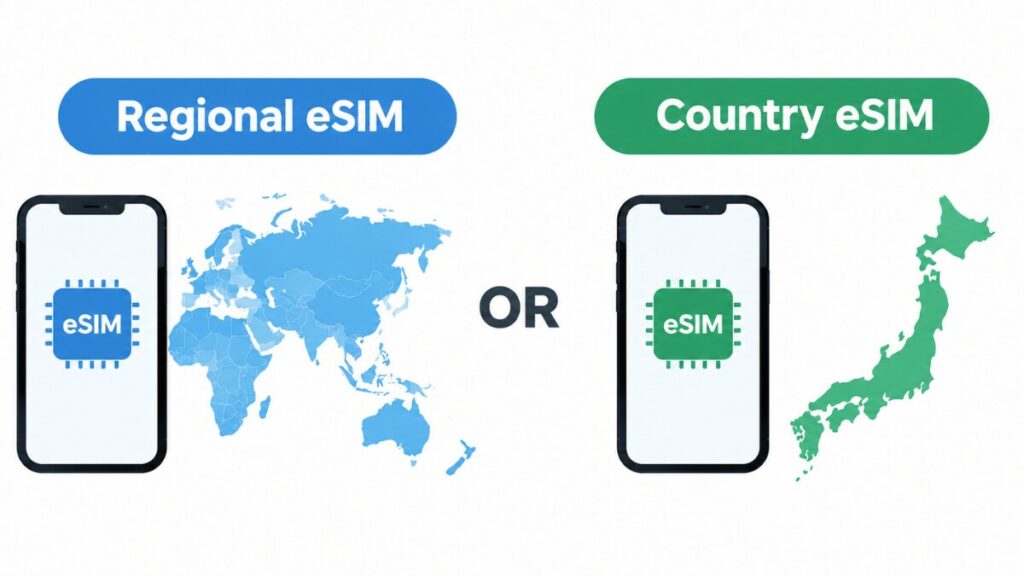
Choose a country eSIM when most of your trip and data use will be in one country. A regional eSIM makes more sense when several countries on your route are included and a single plan offers enough data, suitable networks and sufficient validity. Always compare equivalent plans rather than assuming regional coverage is always cheaper.
| Factor | Country eSIM | Regional eSIM |
|---|---|---|
Coverage | One destination | A defined list of destinations |
Data | Reserved for one country | May be pooled, allocated daily or governed by fair-use terms |
Price per GB | Often lower | May include a convenience premium |
Border management | Another plan is needed after leaving | Usually attempts to register on a partner network |
Best for | Longer stays in one country | Multi-country travel within one covered region |
Key Differences Between Country and Regional eSIMs
Country-specific travel eSIMs serve one destination but may still connect through a roaming agreement with a local network. It is not necessarily the same as an eSIM purchased directly from a domestic carrier. A domestic plan may require identification, local payment details, an address or in-person registration.
On the other hand, a regional eSIM uses one profile across its published coverage list. A Europe regional eSIM might include France, Italy and Germany, but the word Europe does not prove that Switzerland, Türkiye, the UK or every Balkan country is covered.
A global eSIM covers destinations across several regions. It can reduce plan management on a cross-continent trip, although it is not automatically cheaper or available everywhere. Travellers moving between continents can compare global eSIM options against combinations of regional and country plans.
All three are digital SIM profiles. For beginner guidance, you can go through our blog on what a travel eSIM is to get the full picture before comparing how different plan types stack up.
Compare the Total Trip Cost, Not the Headline Price
Research shows that only a small share of international trips cross more than one border, with about 11% of global travel trips including visits to multiple countries, which helps explain why connectivity choices often vary depending on how far and wide the itinerary stretches. That said, the cheapest advertised plan is not necessarily the lowest-cost option for the full trip. Use this calculation:
Total trip cost = required plans + likely replacements + uncovered-country fallback
Compare plans with the same data allowance, similar validity and equivalent features. A regional entry price should not be compared with the combined price of larger country plans.
| Itinerary | Usage Pattern | Options to Compare | Better Starting Point |
|---|---|---|---|
14 nights in Japan | Heavy data use in one country | Japan plan versus an Asia plan with the same data and validity | Country eSIM |
Bali, Singapore and Japan | Meaningful stays in all three | One Asia plan versus three equivalent country plans | Regional eSIM, if all three are included |
10 nights in Thailand and 1 night in Singapore | Most data used in Thailand | Thailand plan plus a small second plan versus regional coverage | Hybrid combination |
UK, France, Switzerland and Türkiye | Frequent borders within 16 days | Europe plan versus four country plans | Regional eSIM, after checking every country |
This route-based comparison is more reliable than adding unrelated prices. You can browse and compare Europe eSIM options or Asia eSIM options with matching allowances and dates.
Account for Shared and Unused Data
Some regional plans provide one shared allowance across every included country. Others use daily limits or different fair-use conditions, so check the product terms before relying on pooled data.
Where data is shared, the benefit can be substantial. With separate 5 GB plans, using 7 GB in Italy, 2 GB in France and 1 GB in Greece requires another Italian purchase while 5 GB remains unused elsewhere. A 15 GB regional plan covering all three would draw the same 10 GB from one allowance.
Country plans can still win when one destination accounts for nearly the entire trip. A hybrid approach often works well when a long stay is followed by one brief stop.
Check Countries, Networks, and Border Coverage

Never buy from the plan name alone:
- List every destination and stopover where mobile data is essential.
- Match each destination against the current included-country list.
- Check islands and territories separately from the mainland country.
- Review the partner networks available in every destination.
- Confirm whether the validity period begins at installation, manual activation or first network connection.
- Save the coverage details and instructions offline.
If one country is excluded, a shared border changes nothing. Add a country eSIM, choose broader coverage or use trusted Wi-Fi. Recalculate the total after adding the fallback.
At an included border, a regional eSIM normally attempts to register on an eligible network. The handover can take several minutes. Follow the supplied troubleshooting steps and do not delete the profile.
Compare Data, Validity, and Hotspot Requirements
| Check | Why It Matters | What to Confirm |
|---|---|---|
Data | Video, backups and laptop work consume data quickly. | Total allowance, daily limits and reduced speeds |
Validity | A 15-day plan may not cover a 15-night trip. | Start trigger and whether a top-up extends validity |
Hotspot | Some plans restrict shared data or speed. | Tethering permission and any separate cap |
Network | 5G depends on the device, location and roaming partner. | Named networks in cities, rural areas and islands |
Calls and OTPs | Many travel eSIMs are data-only. | Whether the Australian SIM can remain active without unwanted charges |
Set the travel eSIM as the mobile-data line and disable data switching to the Australian line unless it is deliberately required. Background data, calls and voicemail on the home service may attract roaming charges.
Set Up the eSIM Before Departure
- Confirm that the phone is unlocked and supports eSIM.
- Read the activation rules and determine whether installation starts the validity period.
- Purchase the plan and install it at the permitted time over reliable Wi-Fi.
- Label the new line with the destination name.
- Select it as the mobile-data line and disable data switching to the home line.
- On arrival, enable roaming on the travel line when the instructions require it.
On iPhone, use Settings > Mobile > Mobile Data to select the data line. iPhone 13 models and later can support two active eSIM lines, although only one mobile data network is used at a time.
For those using Samsung Galaxy devices, go to Settings > Connections > SIM manager or SIM card manager > Add eSIM or Add mobile plan. Menu wording varies by model and software version.
Compatible Pixel devices can store multiple profiles and use two simultaneously when the device and carrier permit it. Always verify the exact model before buying several country plans.
Your Five-Question Buying Checklist
- Does the plan include every essential destination and stopover?
- Does its validity cover arrival through final departure?
- Are its data, fair-use and hotspot limits suitable?
- Do its partner networks cover the planned cities, rural areas and islands?
- Is its total cost still competitive after every fallback or replacement is included?
FAQs
Is a Regional eSIM Cheaper Than Separate Country eSIMs?
Sometimes. Regional value improves when it includes several countries and shared data prevents waste. Separate plans can cost less when you use one country most of the time or need more data. Compare equivalent allowances, validity and features.
Can a Regional eSIM Switch Networks at a Border?
It can register on an eligible partner network when the new country is included. Registration may take time, and the correct roaming and mobile-data settings are still required.
What Happens if One Itinerary Country Is Not Included?
The regional plan will not provide service there. Add a country eSIM, choose broader coverage or use trusted Wi-Fi. The additional cost may remove the regional plan’s advantage.
When Is a Global eSIM Worth Considering?
Consider one when the trip crosses several regions, includes many short stops or covers future trips before the plan expires. It is less compelling when most time and data use sit in one country.