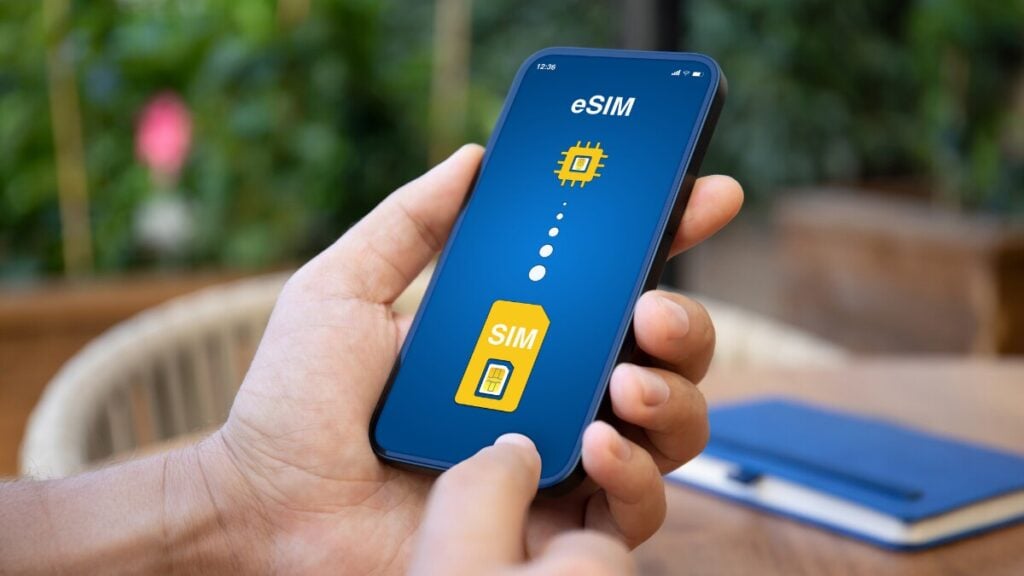
Your maps load and your hotel booking opens, but an ordinary phone call will not connect. When comparing travel SIM and eSIM options, remember that one SIM can supply internet access while another handles your phone number and calls. Those services need separate checks.
What Does VoLTE Mean?
VoLTE means Voice over LTE, a technology that carries ordinary mobile phone calls over a carrier’s 4G/LTE network. LTE stands for Long-Term Evolution. You use your phone’s dialler and a supported mobile voice service, rather than opening a calling app.
VoLTE can provide clearer audio, faster call connection and simultaneous calling and mobile internet use. The results depend on the devices and network involved.
For travel, distinguish the number making the call from the SIM supplying internet access. A data-only travel eSIM can provide connectivity without adding ordinary phone calls to that service.
How Does VoLTE Work?
LTE provides network connectivity. The carrier’s voice system provides the calling service.
With VoLTE, your phone sends voice as digital packets through the carrier’s managed system, called the IP Multimedia Subsystem, or IMS. Your carrier must support calling on that handset and enable it for your service.
Internet access alone does not supply that voice service. A plan can let you browse, stream and use apps while offering no ordinary calling.
Why Can a 5G Phone Still Need VoLTE?
A 5G phone does not necessarily carry every call over 5G. Depending on the network, calls may use 4G VoLTE. Native 5G calling uses Voice over New Radio, or VoNR, where supported.
Some 5G networks move the phone to 4G when making or receiving a call through a process called EPS fallback. A change from 5G to 4G during calling can therefore be normal.
The network symbol alone does not confirm that your phone supports voice roaming at your destination.
Why Can Mobile Data Work When Calls Fail?
Working internet access does not establish that the line selected for calling has a working voice service.
Consider this hypothetical setup. Your travel eSIM loads maps, but your Australian SIM cannot make calls because its overseas voice service is unavailable. Changing the travel eSIM’s data settings will not necessarily fix the home line.
First, identify which SIM the phone is using for the attempted call.
| What Happens | Possible Explanation | Your Next Action |
| Travel data works, but calls from the travel line fail | The plan supplies data only | Check whether the plan includes ordinary voice calling |
| The home number works in Australia but cannot call overseas | Voice roaming is unavailable or incompatible | Confirm roaming is enabled and give the provider your exact handset model and destination |
| The phone shows 4G or 5G but ordinary calls fail | Network access exists without working voice service | Check the selected calling SIM, then confirm service provision and compatibility |
| Calls work at home, but there is no VoLTE switch | Support may be automatic | Check the carrier’s instructions for that handset |
These checks identify the relevant service. They are starting points rather than a diagnosis.
Can a Data-Only Travel eSIM Make VoLTE Calls?
Not simply because your phone supports VoLTE. The actual service must include and provision supported carrier voice calling.
Internet-calling apps use your travel data rather than your mobile carrier’s standard voice service. If you’re using a data-only eSIM, our guide to making calls with a data-only travel eSIM explains the available options.
Keep SMS support separate from VoLTE capability, as the ability to make calls over a mobile network does not mean your eSIM includes standard text messages. If you need verification codes or messages sent to your home number, check how SMS works on data-only eSIMs before relying on them while travelling.
Where Can You Check VoLTE on iPhone and Android?
Start with your exact model number, installed software and calling provider. Imported handsets can have different compatibility despite sharing a familiar product name.
Check VoLTE Support on iPhone
There is no universal VoLTE switch across every iPhone and carrier configuration.
On compatible Telstra 5G iPhones, VoLTE is automatically enabled. Older supported configurations may expose a control under the mobile-data Voice & Data settings. That is carrier-specific guidance, not a guarantee for every iPhone service.
You can also check for updated service-provider settings:
- Connect to Wi-Fi or a mobile network.
- Open Settings → General → About.
- Install an update if prompted.
- Record the version beside Service Provider if technical support requests it.
These steps update carrier settings; they do not verify VoLTE roaming compatibility. A completed update is a preparation step, rather than proof that overseas calling will work.
Check VoLTE Support on Android
Check the mobile-network settings for the intended calling SIM. A control may be labelled VoLTE, 4G Calling or something similar.
If it appears, follow the carrier’s instructions for your exact handset. If it is absent, support may be automatic. A missing VoLTE icon is also inconclusive because its appearance varies by device and roaming location.
Avoid following an old menu path for a different Android model.
Is VoLTE Roaming the Same as VoLTE at Home?

No. Domestic VoLTE support does not guarantee overseas VoLTE calling. Your handset needs roaming compatibility, and your provider needs suitable arrangements with the overseas network. Devices supported domestically can differ from those supported abroad.
Partner networks can change, so a previous successful trip does not establish current support. Check each destination, including stopovers where you intend to use the phone.
Why Do Older Network Closures Matter?
Australia’s 3G networks have already closed. Some older 4G phones also relied on 3G for ordinary or emergency calls, so a 4G specification alone is insufficient. Overseas fallback options are disappearing too. All UK 3G networks had closed by February 2026.
VoLTE is now widely deployed, with GSA’s May 2025 industry report recording 320 operators that had launched or were deploying the technology across 138 countries and territories. However, widespread deployment does not guarantee that VoLTE will work with your specific roaming service.
Does VoLTE Cost Extra?
VoLTE describes how a carrier call is carried, not whether that call is free. Ordinary call inclusions or rates generally apply. For example, Kogan Mobile’s VoLTE billing terms treat it like other voice calls without deducting usage from the mobile-data allowance. Your own provider’s terms determine the charges.
Selecting a travel eSIM for data does not make calls through your home number free. Overseas calls depend on your roaming plan, destination and applicable conditions.
Before departure, check the charges for outgoing calls, incoming calls and voicemail on your home plan. Learn how to avoid roaming charges when travelling by checking your home SIM settings before using your phone abroad.
What Should You Ask Your Provider Before Travelling?
Gather these answers in one place:
- Does this exact handset model and software support voice roaming in each destination?
- Is international voice roaming available and enabled on this plan?
- Which overseas partner networks support the service?
- What are the charges for outgoing calls, incoming calls and voicemail?
- Does the handset meet the relevant emergency-calling requirements?
Label your lines clearly, such as Home Calls and Travel Data. Confirm the intended calling number and preserve your chosen mobile-data line when reviewing settings.
How Does VoLTE Differ from Wi-Fi Calling?
VoLTE carries calls over an LTE mobile network, while Wi-Fi Calling connects to a supported carrier’s calling service through Wi-Fi. Both require a compatible device and carrier support, although their setup requirements differ.
Our guide to Wi-Fi Calling on iPhone explains how the feature works and what you need to enable it. Unlike app-based calling, Wi-Fi Calling uses your mobile carrier, so overseas availability and charges depend on your provider.
What Does VoLTE Mean for Emergency Calls?
Regular calls and emergency calls have different compatibility requirements. Even if your mobile data works and you can call friends or family, that doesn’t necessarily mean your phone can connect to emergency services.
Confirm your handset, carrier and destination requirements. Do not apply Australian requirements automatically to another country or call an emergency number to test compatibility.
It’s also worth understanding how emergency calling works with a travel eSIM, as internet-based calling apps cannot be relied upon as a replacement for local emergency services.
Should You Turn VoLTE Off When Travelling?
Do not disable it by default. It may be required where older calling networks are unavailable. If a call fails, identify the selected calling line first. Then establish whether that line includes voice service and supports roaming on the available network.
Always follow the provider’s instructions before changing network settings.
Before You Leave
Complete the provider checks above, install available software and carrier updates, and confirm which line handles calls and which supplies data. Save the relevant support details somewhere accessible offline so a failed call does not leave you searching for instructions after arrival.